
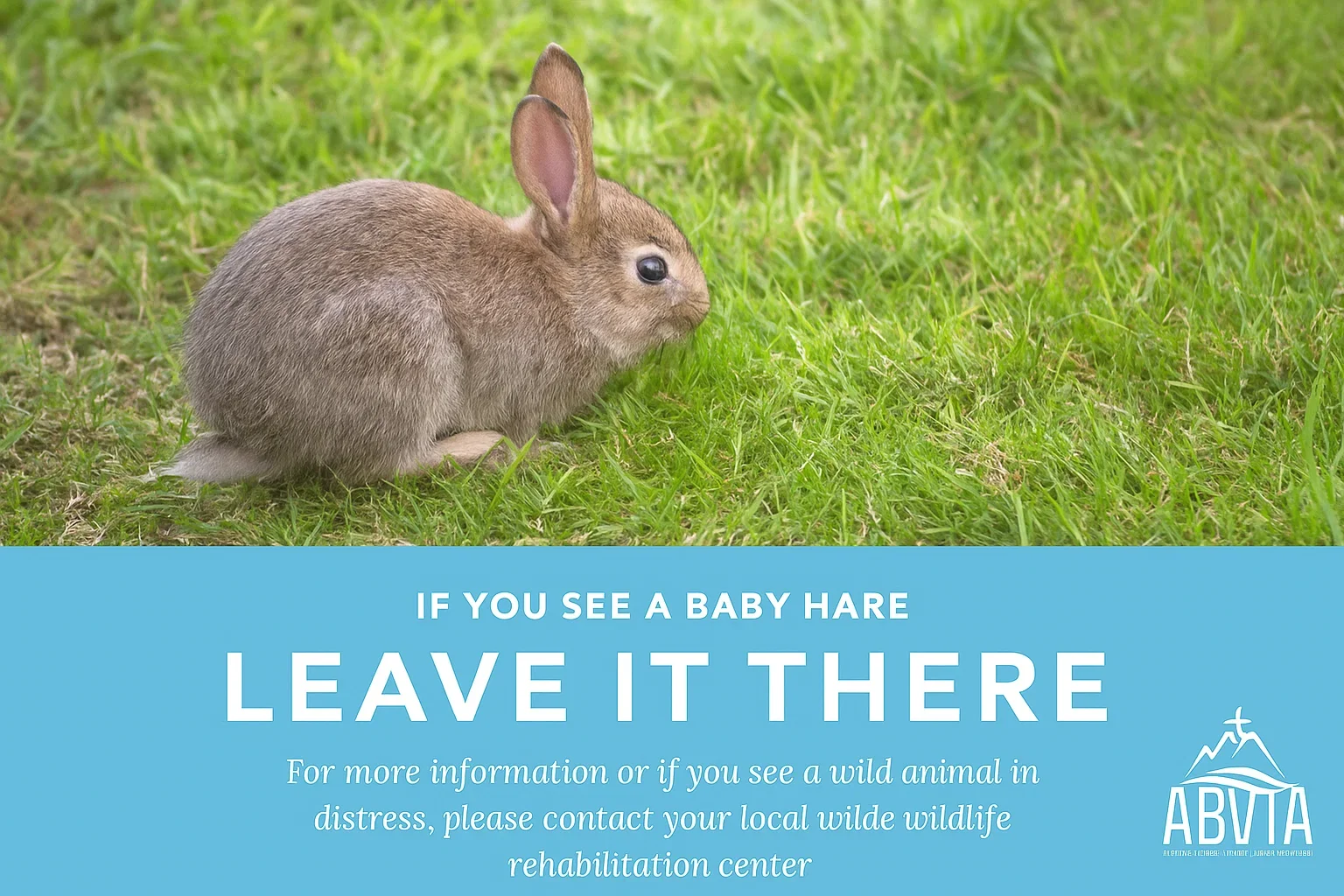
Prairie Hares (jackrabbits) prefer open spaces such as urban neighbourhood parks, yards, public parks, and schoolyards, while Snowshoes prefer forested areas.
The key feature that separates hares from rabbits is the way their young are born. Baby hares are born precocial (fully furred, eyes open, and able to hop about within hours of birth). They do not stay in a “nest” and the litter separates within days of birth. Rabbits, on the other hand, are born altricial (naked, eyes and ears closed, not mobile). They burrow and make a nest until the young are old enough to move about on their own. There are Mountain Cottontail Rabbits in southern Alberta.
Wildlife rehabilitation centres, humane societies, and veterinary clinics will usually receive calls about “baby bunnies” starting in April. Many people think they have been abandoned because they are found alone. It is actually normal for baby hares to be alone with Mom nowhere in sight.
The most important piece of advice is:
“IF YOU SEE A BABY HARE, LEAVE IT THERE.” |
If it is not obviously injured or in a dangerous place (like the middle of a parking lot), do not handle it or stress about it. It is where it should be. If it is in a dangerous location (parking lot, construction site), look for the nearest green space and, using gloves, gently and quickly move it somewhere safer. If there are predators (crows, magpies), it’s alright to keep the animal out of sight until it’s a bit darker, then place it outside. They are nocturnal animals and are more active at night.
It is not true that the female will abandon them if they have been touched by humans. Baby hares can be returned to the area where they were found even if they have been handled. It is best to do this as quickly as possible.
Hares are a prey species, which means they are born in litters of multiple animals (4–6), and females will have several litters per year. The female attends to the babies in the evening to nurse them briefly.
Baby hares do not survive well in captivity. Good-hearted people are often heartbroken when the baby they “saved” dies due to the stress of handling, changes in milk formula, or an unnatural captive environment. Wildlife can also carry diseases and parasites that may not be immediately visible. For this reason, and because of the poor survival rate in captivity, the best approach is to educate and leave it there.
You can refer callers to Alberta Wildlife Rehabilitation Centres for this or other wildlife concerns:
Alberta Wildlife Rehabilitation Centres
- Alberta Institute for Wildlife Conservation – 403-946-2361
- Calgary Wildlife Rehabilitation Society – 403-214-1312
- Cochrane Ecological Reserve – 403-932-5632
- Medicine River Wildlife Centre – 403-728-3467
- WildNorth Wildlife Rescue and Rehabilitation – 780-914-4118
Centres for Raptors
- Alberta Society for Injured Birds of Prey (Strathcona Raptor Shelter) – 780-922-3024
- Alberta Birds of Prey Foundation – 403-331-9520